Here we are - There we go


8, 9 and 10 May 2009 - 30th Anniversary open house weekend

The Netherlands Media Art Institute celebrated its 30th anniversary! We did this with an open house on 8, 9 and 10 May, a long weekend full of discussions, visual art and technology. We lifted a glass to the future, and invite everyone to think along with us about the art of today and tomorrow, about media art and digital culture in all its colors and keys. What fundamental changes in our lives will accompany technological innovation? What influence is tomorrow's digital environment having on artists today? And what will this mean for an institution like the NIMK? This moment is an ideal opportunity to determine where we stand, and to look ahead to the future.

Link to the full programme

The link to the video

The link to the photos

The Netherlands Media Art Institute's mission is to support and encourage the free development of media art. Over the past thirty years this art form, which is defined by its connection with technology, has experienced an enormously diverse development: from video art, performance and work on Super8, via internet and Second Life to wearable technology and blogs. What has continued to fascinate us through all these years is precisely this growth and development, the flexible use of one new technology after another, and the creativity shown by artists in doing so.

René Coelho, the founder of Montevideo, always had a short and simple answer when asked for a definition of media art: "It is art with a plug." The manifestations of media art have changed immensely since that time, but in essence he is still right. Media art has taken on many shapes which are not always easy to fit – or even to twist – into the definition of 'Art'. Media art now includes works made with ever more advanced new technologies: digital art, computer graphics, virtual art, computer animation, robotics, internet art, interactive technologies and biotechnology.

Their diversity will not only define our future, but also challenges us to continually come up with innovative solutions in the different activities which connect the Institute with media art : exhibitions, collection, distribution and promotion, preservation, production, research, reflection and education. We want our activities to be trend-setting and produce food for thought, and work together with many individuals and institutions, here in The Netherlands and internationally, to that end. We therefore dedicate the open house weekend in honor of our 30th anniversary to all those who have supported us over the course of the years, and we hope for many productive years of collaboration with them ahead.

Wearable Technology - Powered Art and Fashion Design

Exhibition and series of presentations and performances

July 15 – 19, 2009
Netherlands Media Art Institute in cooperation with 5days off festival

Link to the exhibition website


Video documentation of the exhibition in Amsterdam

Video documentation of the live show in Amsterdam

Link to photos

From 15-07-2009 until 19-07-2009


A program by the Netherlands Media Art Institute in collaboration with 5-days off festival

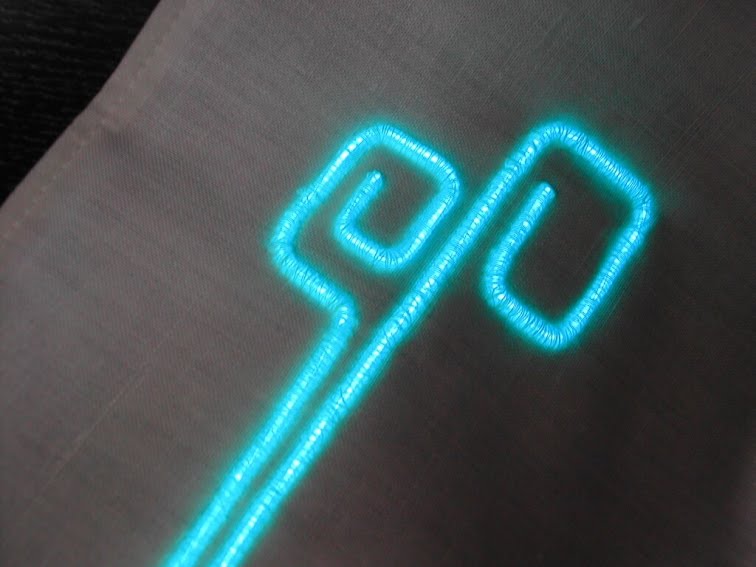
‘Wearable Technology – Powered Art and Fashion Design’ presented latest developments in the area of technologically augmented clothing. The program crossed the disciplines of fashion design, performance art, wearable computing and interaction design. The selected pieces envisioned a future in which our second skin, our clothes, become relevant element in our social life, in our communication and interaction with others. This is achieved by embedding electronics seamlessly into the textiles. After the miniaturisation of processors, sensors and batteries designers can now use these to create expressive and performative garments beyond the everyday experience. And whilst artists use the same technologies, their pieces have a different objective – they visualise the density of our highly technical world and the invisible flood of data surrounding us. The program was designed around the idea of demonstration and knowledge transfer. The Netherlands Media Art Institute hosted the exhibition and the designers’ and artists’ talks. Almost all artists and designers were present in Amsterdam during the festival and give insight into their practice in the forrm of moderated talks.

Sabine Seymour, author of the book ‘Fashionable Technology’, and expert in the field of wearables contributed with an illustrative lecture.


The performative and expressive nature of the pieces were demonstrated at the opening at Melkweg. Models worn the high-tech clothes and accessories in a live show and gave the audience the opportunity to explore and experience the designs. The program mirrored the current design and art scene engaged in wearable technology. The inspiring selection comprised by curator Susanne Jaschko was developed and produced in the Netherlands and in other European countries, as well as North America.

It showcased work by: Laura Beloff (FI) / Erich Berger (AT) / Elina Mitrunen (FI), Elena Corchero (ES), Margarete Jahrmann (AT), Sarah Kettley (UK), Di Mainstone (UK), Barbara Layne (CA), Stijn Ossevoort (NL), Marina Toeters (NL), Markus Kison (DE), Casey Reas / Cait Reas (US), Joanna Berzowska (CA), Danielle Wilde (AU), Mauro Arrighi (IT) / Anika Hirt (DE) / Onur Sonmez (TR), Anja Hertenberger (DE) / Barbara Pais (PT) / Danielle Roberts (NL), Nicky Assmann (NL). Next to wearables by artists and designers, the exhibition features work by artist Boris Tellegen (NL).

Curated by Susanne Jaschko
Curatorial Assistance: Elena Catalina Pérez

Programme

July 15
Location: Melkweg Max
Start: 20:00
Opening show of ‘Wearable Technology – Powered Art and Fashion Design’ with performances and demonstrations

July 16
Location: Netherlands Media Art Institute
11:00 – 19:30 Exhibition ‘Wearable Technology – Powered Art and Fashion Design’
19:30 Lecture by Sabine Seymour, author of Fashionable Technology
20.15 – 21.30 Talks by participating artists and designers:
Di Mainstone (UK): ShareWear
Marc Beaulieu and Di Mainstone (CA/UK): Skorpions
Nicky Assmann (NL): Circuit Dress
Mauro Arrighi (IT): DADAgear

July 17
Location: Netherlands Media Art Institute
11:00 – 19:30 Exhibition
19:30 – 21:00 Talks by participating artists and designers:
Barbara Layne (US): Jacket Antics and Tornado Dress
Markus Kison (DE): Vanity Ring
Marina Toeters (NL): Triangled Coat and Huggy Care
Sarah Kettley (UK): Stille and Speckled Jewellery

July 18
Location: Netherlands Media Art Institute
11:00 – 16:00 and 18 – 21:00 Exhibition
16:00 – 18:00 Talks by participating artists and designers:
Stijn Ossevoort (NL): Flare and Perfume Jewellery Pieces
Elena Corchero (ES/UK): Solar Vintage
Anja Hertenberger (DE) / Barbara Pais (PT) / Danielle Roberts (NL) e-Pressed
Danielle Wilde (AU): hipDrawing

July 19
Location: Netherlands Media Art Institute
11:00 – 20:00 Exhibition
Come and try some of the pieces on!
Visitors information:

More information 5 days off: www.5daysoff.nl


Thanks to:
Mondriaan Foundation
Barbara Layne (CA)

Symposium Positions in flux: On the changing role of the artist and institution in the networked society


Organised by Netherlands Media Art Institute (NIMk), Amsterdam
Symposium venue: Trouw Amsterdam
on Friday, May 8th, 2009

Link to the photos


The symposium Positions in flux: On the changing role of the artist and institution in the networked society
will center on some of the major parameters for the current and future development of contemporary art. In particular it will reflect on the aspect of cultural sustainability of art projects, art and technology initiatives and art curating.

Positions in flux will give floor to international artists, theoreticians, critics, cultural producers and aims to initiate a truly critical debate. The symposium is designed for a broad audience working in the field of contemporary culture and art, with a desire to understand what comes ahead and how to respond to these changes on an artistic or institutional level. Positions in flux will provide a platform and “thinkspace” for artists, cultural workers, theoreticians and a broader public to envision the future in our field and to provide us with the necessary information to make choices for a meaningful and sustainable development of society and culture.

The three panel discussions follow a clear thematic scheme and try to bring in as much expertise and viewpoints as possible. The panels are interlinked and designed to initiate an ongoing discussion among the participants. The conference language is English.

The symposium will be streamed from the symposium venue, Trouw Amsterdam. Online audiences will have the opportunity to participate in the debate in the live discussion forum. The results of the debate and its main contributions are reviewed and published online on the New Media Art Platform.

The symposium is part of the Here we are – There we go programme at the Netherlands Media Art Institute, May 8th – 10th, 2009 which takes place on the occasion of the Institute’s 30th anniversary. Here we are – There we go celebrates the Institute’s achievements in these thirty years and plans for the future with an inspiring open house weekend of artist talks, performances, installations, tours and a party.

Positions in flux is made possible with the kind support of the Mondriaan Foundation.

Curator: Susanne Jaschko
Curatorial Assistance: Elena Catalina Pérez

Speakers and panels. Full Programme:


9:00 – 10:00 Registration

9:45 Welcome and Introduction
by Heiner Holtappels, director of NIMk and the symposium's curator Susanne Jaschko

10.30 – 12.30 Panel 1: Art goes politics
In this session we will discuss the potential of art to contribute to global and local problems such as religious conflicts, environmental or social crisis. Or is art constrained to raising awareness only? Should art become an agency for political and social affairs at all? How to successfully implement and conduct art projects in zones of crisis? What does it take to successfully implement and conduct projects in zones of crisis? How far do these projects benefit from the dubious attention of mass media?

Hans Bernhard (at), artist, UEBERMORGEN.COM
UBERMORGEN.COM is an artist duo created in Vienna, Austria, by Lizvlx and Hans Bernhard, a founder of etoy. UBERMORGEN.COM’s open circuit of conceptual art, drawing, software art, pixelpainting,
computer installations, net.art, sculpture and digital activism (media hacking) transforms their brand into a hybrid Gesamtkunstwerk. The computer and the network are (ab)used to create art and combine its multiple forms. The permanent amalgamation of fact and fiction points toward an extremely expanded concept of
one’s working materials, that for UBERMORGEN.COM also include (international) rights, democracy and global communication (input-feedback loops). Lately UBERMORGEN.COM generated a lot of media attention with their projects ‘The Sound of Ebay,’ ‘Amazon Noir - The Big Book Crime’ and ‘GWEI - Google Will Eat Itself.’
www.ubermorgen.com

Wafaa Bilal, artist (iq/us)
Bilal grew up under the repression and violence of the Baathist regime in Iraq and considers himself a political artist, dealing with war and oppression, and the Iraqi experience. Bilal's 2007 dynamic installation ‘Domestic Tension’ placed him on the receiving end of a paintball gun that was accessible online to a worldwide audience, 24 hours a day. Newsweek called the project “breathtaking” and the Chicago Tribune called the month-long piece "one of the sharpest works of political art to be seen in a long time." He is assistant professor at the Tisch School of the Arts at New York University.
www.wafaabilal.com

Knowbotic Research, artist group (de/ch), artist in residence at NIMk 2008/09
While the earlier, network-based projects by Knowbotic Research had concentrated on structures important to virtual networks, their recent test cases emphasise the aspect of transcoding in real spaces. By 'transcoding', Knowbotic Research mean the translation of abstract social and political facts and conditions which are removed from the classical public sphere, into situations that can temporarily be observed and negotiated.
www.krcf.org

Moderated by Chris Keulemans, writer and journalist (nl)
‘Art After Crisis’ is a website by traveling writer Chris Keulemans. Ever since his first visit to wartime Sarajevo, he has been fascinated by the way artists reinvent their work, their city and their life after a period of war or dictatorship. Their art often occupies empty spaces in a city struggling to recover. It finds a place for traumatic and violent memories, it mirrors the shaky present and it looks forward while others are still paralysed.
http://roadtrip.submarinechannel.com/content/view.jsp?mapid=5986&itemid=4897&menu=true

12.30 – 13.30 Lunch break

13.30 – 15.30 Panel 2: New territories and cultures of the digital
This panel will look at the geographical shift that media culture currently undergoes and that will shape the future of this field. In the past, Europe, North America and Japan were at the forefront of digital production, design, art and technological research. Now that digital technologies become available at lower prices and spread more widely on the globe, new digital communities flourish. This panel looks specifically at new initiatives and bottom-up organisations in other parts of the world such as East Europe, the Middle East, Africa and South America, trying to understand what characterizes these initiatives. In how far do local and national cultures shape digital culture? Do these initiatives share common experiences and challenges, or is there no common ground to be found? Which kind of art arises from these new nodes on the digital map? How can we support the growth and establishment of these organisations?

Bronac Ferran (uk), researcher, consultant and founding member of bricolabs
Ferran’s current projects include a cultural mapping of digital culture in Brazil for SICA in the Netherlands. The bricolabs initiative links individuals and grassroots organisations working with media technologies in a hands-on, DIY way, across the world. Bricolabs was heavily informed by developments in social technology settings in Brazil particularly work there with recycled materials and collaborative approaches to knowledge sharing, open source and free software. Ferran is also Senior Research Tutor at the Royal College of Art in London, for the Industrial Design Engineering Department.
www.boundaryobject.org

Nat Muller, independent curator and critic (nl)
Muller an independent curator and critic based in Rotterdam with a specific focus on (new) media and art in the Middle East, media and politics and the intersections of aesthetics. She has held positions as project curator at V2_, Institute for Unstable Media (Rotterdam) and De Balie, Centre for Culture and Politics (Amsterdam). She has taught at the Willem de Kooning Academy (NL), the Lebanese American University in Beirut (LB), ALBA (Beirut) and A.U.D (Dubai). Recently, she was curator-in-residence at The Townhouse Gallery in Cairo.

Marcus Neustetter, media artist, curator and co-founder of Trinity Session (za)
Neustetter is conducting research and developing projects in the field of new media art. In 2000 he launched sanman (Southern African New Media Art Network), a resource that promotes new media art and technology amongst audiences and artists in Southern Africa and networks companies, institutions and individuals that share similar interest in this field. In his role as facilitator, curator and cultural producer he is actively developing new projects that blur the boundaries of the traditional application of the creative idea. These processes involve both workshop programmes and development strategies of practitioners and audiences of digital and electronic art in a third world context, investigating the possibilities of sustainable relationships to the existing under-supported art structure and current development of corporate new media activity.
www.onair.co.za/thetrinitysession/index_temp.html

Adam Somlai-Fischer, artist and architect, programme director of Kitchen Budapest (hu)
Somlai-Fischer is one of the key generators of the content created at Kitchen Budapest. Kitchen Budapest, opened in June 2007, is a new media lab for young researchers who are interested in the convergence of mobile communication, online communities and urban space and are passionate about creating experimental projects in cross-disciplinary teams. An architect and interaction designer, Somlai-Fischer is interested in the cultural qualities of new technologies, and to explore these he creates installations and experiments that blend spaces, technologies and interactivity.
www.kitchenbudapest.hu

Moderated by Rob van Kranenburg, thinker, networker and author (nl/be)
Van Kranenburg has been teaching at various schools in the Netherlands (UvA, EMMA Interaction Design, Industrial Design). Currently he works as the Head of the Public Domain Program at Waag Society. He is author of ‘The Internet of Things.’

For this session we will ask initiatives and organisations around the world to come up with a short written or a 1 minute video statement about challenges they face in the future.
These contributions will be shown during the panel.

15.30 – 16.00 Coffee Break

16.00 – 18.00 Panel 3: Open Source – A scheme for art production and curating?
This session deals with the concept of open source for art production and its presentation. The open source movement is driven by the idea of collective, process-based, sustainable production and improvement. In software development this strategy has already proven to be valid; however can this model be applied to other products such as artworks or even exhibitions? In how far does the open source model differ from other forms of artistic collaboration? Is there a new role model for both the artist and the curator in the future? Which (economic) value and impact has expertise in open source production? How could institutions and organisations respond to this trend?

Marcos Garcia, director of Interactivos, Medialab Prado (es)
Medialab-Prado is aimed at the production, research, and dissemination of digital culture and operates at the intersection of art, science, technology, and society. Its primary objective is to create a structure where both research and production are processes permeable to user participation. It has developed a unique workshop model for collaborative art production and knowledge transfer.
www.medialab-prado.es

Jaromil, dyne.org and researcher at NIMk
Denis 'Jaromil' Roio is the main author of the GNU/Linux Live CD Dyne:bolic as well as of a number of audiovisual tools. He is also an artist who has been part of international exhibitions such as CODeDOC II by the Whitney Museum Artport and speaker on conferences such as Ars Electronica. Inspired by Richard Stallman's "free as in free speech" approach as well as liberatory politics, Jaromil seeks to transgress borders between art and code, social activism and research and development.
http://jaromil.dyne.org/journal/

Joasia Krysa, curator, founder of KURATOR (pl/uk)
KURATOR is a cultural organisation operating as a curatorial agency and research platform at the intersection of art and technology. It has a particular interest in an emerging discourse and practice that links curating with software and networks. Krysa’s recent curatorial projects include openKURATOR, an open submission and presentation platform developed by KURATOR. She is the editor of ‘Curating Immateriality’ (Autonomedia, New York 2006) and lecturer/researcher at the AZTEC (Art Science Technology Consortium at the University of Plymouth.
www.kurator.org

Moderated by Susanne Jaschko, chief curator NIMk (de/nl)
Jaschko is curator in contemporary art with a focus on electronic and digital art. Before she was curator of transmediale – international festival for art and digital culture in Berlin. Current curatorial projects include ‘Process is Paradigm,’ an exhibition at LABoral, Spain, investigating ephemeral art building on time and contingency, on interdependence and change.
www.sujaschko.de

Producer: Elena Pérez


Fluid Architectures


30 May - 16 August 09 at Netherlands Media Art Institute
Opening: 29 May 09

Download introduction in English


Link to exhibition website

Video documentation of exhibition


Video by Antonio Glessi on Marnix de Nijs' Exploded Views, contains excerpts of an interview with Susanne Jaschko.


In the movie Metropolis from 1926, director Fritz Lang created the vision of a futuristic 21st century mega-city. Now that we have crossed the threshold of the this century our reality makes that vision seem strangely old-fashioned as new sets of factors unconsidered by Lang move to shape the future of our urban spaces. It is now ubiquitous computer networks, information delivery in real time and new display technologies which are the key elements transforming the face of our urban living spaces. Through them a space is taking shape whose manifestations merge the virtual and the physical.

Essayist Florian Rötzer talks in this context of a “digital urbanism” whose salient features are „dispersal, decentralisation, valorisation of interiority, globalisation, individuality and mobility“.
These factors shape a networked society and a "space of flows” which generate new dimensions for imagination and action no longer concurrent with the old geographies and topographies.

The exhibition Fluid Architecture gathers spaces of flow and immateriality created by artists in response to these contemporary notions of space. These fictional spaces made of light, moving image, and other media extend the idea of physical architecture to the construction of dynamic and seemingly infinite spaces enabling a sensory experience. The works rethink the classic standards of spatial construction and topography. Rather they introduce the new concept of performative architecture and thus propose an imaginary urban landscape for the 21st century.
For Fluid Architectures new site-specific works will be created by Walter Langelaar, Jan Robert Leegte and Pablo Valbuena.
The Fluid Architectures programme comprises a gallery exhibition, lectures and workshops.

Artists and works:
Annja Krautgasser (AT): Dashed II, media installation, 2005

Walter Langelaar (NL): paralevel | OA_NIMK2, modified videogame software, projection, 2009 (commission)

Jan Robert Leegte (NL): Ornament (Amsterdam), computer projection, 2009 (commission)

Dirk Lüsebrink/Joachim Sauter (DE): Invisible Shapes of Things Past - Shanghai, film-based sculptures and prints2D and 3D print, video, 1996/2006

Mader Stublic Wiermann (DE): folded space and twists and turns, documentations of video installation, 2008

Michael Najjar (DE): the invisible city, video, loop, 2004

Mark Napier (US): Smoke, custom software, computer, projection, and Cyclops Birth I + IV, inkjet on paper, 2007

Marnix de Nijs (NL): Exploded Views – Remapping Firenze, multi media installation, 2008 (produced within NIMk’s artist in residence programme)

Stanza (UK): Urban Generation, net art, software, real time city experience, 2005

Pablo Valbuena (ES): Extension series, architecture and projection, 2009 (commission)

Frame programme:
May 29, 2009
18.30 h Introduction into Fluid Architectures by Susanne Jaschko
19 h Lecture 'Digital urbanism - historical and and future utopias of the megacity' by exhibiting artist Michael Najjar

June 10
19 h Lecture by exhibiting artist Jan Robert Leegte

June 13
11 – 19 h Workshop by exhibiting artist Walter Langelaar


Curator: Susanne Jaschko
Curatorial Assistance: Elena Catalina Pérez

Wearable Technology - between fashion and art.


Exhibition and series of presentations and performances

May 14 – 17, 2009
Edith-Ruß-Haus für Medienkunst in cooperation with the Netherlands Media Art Institute

A jacket that shows us the way? A dress on which you can play computer games with people? A sweat-shirt you can perform poetry with?

More and more designers and artists nowadays are experimenting with new technologies and creating articles of clothing that can do more than just look good. Artist designers integrate, for example, sensors or LEDs in clothing, thus creating wearable objects that not only attract attention, but can also be useful in everyday life, facilitating communication and interaction and bringing out their wearer’s individuality.

At the I-Machine Festival the Edith Russ Site for Media Art is presenting, in cooperation with the Netherlands Media Art Institute, a programme devoted to wearable technology. On display will be the creations of international designers and artists whose work is devoted to exploring the technical and aesthetic possibilities of wearable fashion and art. Besides exhibiting these “wearables” the programme also includes the live presentation of articles of clothing at various places in Oldenburg. The designers will talk about their work on two evenings.

Visitors will not only be able to view the creations, but to try some of the “wearables” on. They will also be able to make their own “wearables” in two workshops.

Artists: Kristina Anderson; Mauro Arrighi, Anika Hirt, Onur Sönmez; Laura Beloff, Erich Berger, Martin Pichlmair und Elina Mitrunen; Marguerite Charmante; Barbara Layne; Di Mainstone; Markus Kison; Ebru Kurbak, Ricardo Nascimento und Fabiana Shizue; Stijn Ossevoort; Merlinda Prizreni, Ka-min Lung, Jos Herder, Michiel Rotgans, Ana Resende, Melissa Bonvie und Suze Ruyten; Danielle Roberts, Anja Hertenberger und Barbara Pais; Gordan Savicic; SOS Design Studio

Curated by Susanne Jaschko,
Curatorial assistance: Elena Catalina Pérez

See the full programme here

Primarily Language


Screening with works from the NIMk collection in relation to the Speaking Out Loud exhibition
January 20, 2009 at Netherlands Media Art Institute
Curated by Susanne Jaschko in collaboration with Elena Pérez

Throughout the history of video art, artists have devoted their work to the the subject of language. Particularly in the 1970s and 1980s, a number of outstanding works were produced which celebrate language and its relation to image, imagination and memory. The NIMK / Montevideo collection holds some of these seminal video works and later ones and presents them in a screening within the context of the current Speaking Out Loud exhibition.
The introduction will present excerpts of Freeing the Memory, 1976, by Marina Abramovic, Primarily Speaking, 1981, by Gary Hill and Studies in myself II ,1973, by Douglas Davis.

-Exploring the human (un)consciousness-

Michel Chevalier
Hand to Mouth, Volume I (English), 1999, involves concrete research on the working of the area where language is processed in one's own brain.

-Cut-outs-

Han Bierman
Untitled I/Untitled II, 1981, leads to an absurd and grotesque spectacle by manipulating well-known newscaster Joop van Zijl's discourse.

eddie d
Pas de deux, 2007, presents interchangeable moments where political leaders or other talking heads have arrived at a pathetic, faltering cul de sac of language and movement.

-Image/word-

Peter Savage
It is Like Reading a Word, 1979, addresses topics such as interpretation, understanding and communication.

-Persuasive Speech-

Antonello Faretta
Just Say NO to Family Values, 2006, conveys burning poetry by John Giorno.


See fragments of the videos here

Speaking Out Loud


15 November 08 – 24 January 09, opening 14 Nov 08
Netherlands Media Art Institute
Curator: Susanne Jaschko
Curatorial Assistance: Elena Catalina Pérez
Kindly supported by the Goethe Institute Amsterdam, Jacot Audiovisuel and Beamsystems

Speaking Out Loud centers on the processes of both “thinking out loud” and “speaking out.” Thinking out loud describes the associative, dynamic and rather uncontrolled process of simultaneously thinking and speaking about a particular topic. We think out loud to make a suggestion, to put forward an idea or a thought rather than to make a claim. Speaking Out Loud advocates this free and creative process of thinking out loud through artworks that enable a playful and surprising experience of language. This happens in the form of what could be summarised as experimental language exercises or canny transformations and alternations of language.

Meanwhile the act of speaking out demonstrates resistance and the existence of alternative concepts and views. As a democratic act it constitutes a cornerstone of democratic society. In that sense, the exhibition promotes the idea of controversy, dissent and debate as a relevant society shaping strategy. In the light of representative democracies, low voter participation and increasingly levelled concepts of life, Speaking Out Loud attempts to call for taking an active role in the debate. Moreover it explores the subversive power of spoken or written text but also unmasks the inflationary and culturally connoted use of words and phrases.

The artworks in the exhibition deal with the act of speaking, reading and writing. They particularly reflect on and emphasise the performative qualities of language and thus reveal the strong and inseparable connection between words' meaning and their performance/performer.
Renowned novelist Paul Auster captured the act of speaking as “When words come out, fly into the air, live for a moment, and die. Strange, is it not?” It is this fluidity and dynamics of language and its meaning that the exhibition centers on, observes and reflects.

In this fluid state, words fly and dance, thus enabling a mental dialogue between the artwork and its viewer/listener, and opening up to continuous interpretation.
The exhibition mainly presents works of Dutch and English language. Thereby it also reflects on a world in which vast distances are bridged with relative facility but where language remains a system of cultural “multivalence.”


List of works in the gallery:
Insults and Praises by Tim Etchells (UK) and Vlatka Horvat (CRO)
A New and Exciting Experience by Mukul Patel (UK) and Manu Luksch (AT)
Good and Evil by Charles Sandison (UK/FI)
Interpreters by Christoph Keller (DE)
Time Based Text by Jaromil (IT/NL) and jodi (NL)
Gate peepin' and Misspelling Generator by Linda Hilfling (DEN)
Horde by Karl-Heinz Jeron (DE)
A Conversation Piece by Tudor Bratu (RO)
Text and Semiotic Collider by Michael Hoepfel (DE)
Gelsomina by Trikoton (DE)
Explicit Content Only by Evan Roth (US)

Intervention at the opening:
Omer Krieger (IL)

Performances at the opening:
Bas Boettcher (DE) and Blaxtar (NL)

See review

See photos